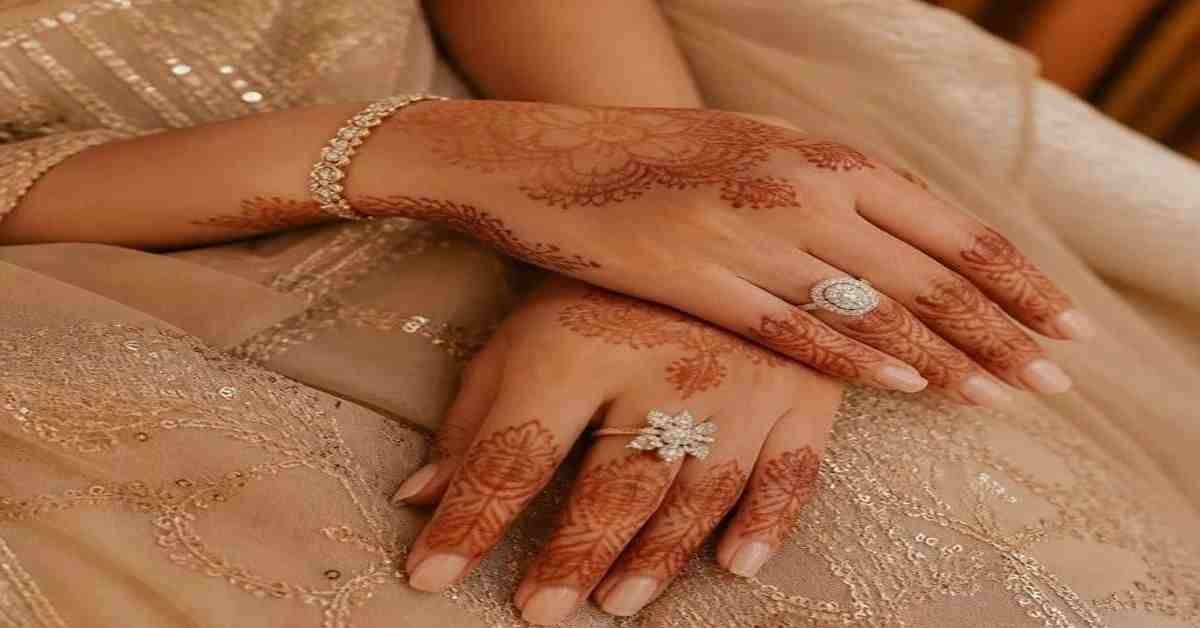
Henna changes the rules of jewelry styling. For two weeks after a mehndi night, the hands carry their own pattern, their own rhythm, and their own color story—deep maroon fading to cinnamon. Any bracelet, ring, or pair of earrings you add has to work with that, not fight it. The usual advice about “stacking statement pieces” collapses the moment there is already lacework drawn across the skin.
This guide approaches the question from the jewelry side: which diamond pieces read beautifully against fresh henna, which ones disappear, and how to plan a set for a mehndi ceremony, a wedding function, and the quieter weeks that follow when the stain is still visible but softer.
Why diamonds and henna work together
Henna is matte, warm, and intricate. Diamonds are glossy, cool, and dimensional. That contrast is the whole reason the pairing works. A reddish-brown motif absorbs light; a brilliant-cut diamond throws it back. Put them near each other, and each becomes more noticeable.
Metal choice matters more than most people expect. Yellow gold sits in the same warm family as henna and can blend into it at arm’s length, which is lovely for a traditional look but less effective if you want the jewelry to be seen. White gold does the opposite: a cool, bright frame that makes the stain read darker and the pattern read sharper. Pieces crafted in 14K and 18K white gold are, for that reason, a dependable choice for henna-heavy events, especially with pale or jewel-toned outfits.
Read the density of your design first
Before choosing anything, look at how much skin your henna actually covers. A full bridal design running from fingertips to elbow leaves almost no negative space; a modern minimal vine along one finger leaves plenty. Dense designs want fewer, cleaner jewelry pieces. Open designs can carry more.
Earrings do the heavy lifting during mehndi week
When the hands are busy, the face becomes the place to add sparkle without competing. This is the practical argument for earrings over rings and bangles in the days around a mehndi ceremony: they sit far from the pattern, they photograph well in candid shots where hands are raised, and they never smudge drying paste.
- Solitaire round studs are the most forgiving option. They read as light rather than as an object, so they never argue with embroidery, a dupatta, or a dense henna sleeve.
- Cluster studs give you more visible surface sparkle at a smaller overall scale—useful if you want presence, but your outfit already has heavy neckwork.
- Motif studs such as heart or clover shapes echo the floral logic of henna without copying it, which usually looks more intentional than matching motifs exactly.
- Gemstone-accented squares with emerald, ruby, or sapphire accents are the one case where a warm, saturated color near the face genuinely helps: jewel tones and henna share an old visual vocabulary.
A practical note on scale: studs that look modest in the mirror often look right in photographs, because camera flash exaggerates sparkle. If you are deciding between two sizes for a daytime function, the smaller one usually ages better in the album.
Hands, wrists and the bracelet question
Bracelets are the trickiest category during henna season because they physically overlap the artwork. A wide cuff can hide the strongest part of a design—and if your pattern runs across the back of the hand and wrist, as it does in most traditional layouts, that is precisely the area you have spent hours decorating. Readers planning their own motifs will find it worth studying how a back hand mehndi design flows from the knuckles toward the wrist, because that line determines where a bracelet can sit without cutting the composition in half.
A diamond tennis bracelet solves this better than most alternatives. It is narrow, continuous, and transparent in effect—a single line of light rather than a block of metal. Worn slightly loose, it drapes over the pattern instead of covering it. If you are shopping for one, learn the vocabulary of settings, link flexibility, and clasp security before you compare pieces; a practical primer such as this diamond tennis bracelet buying guide explains why clasp design and link construction matter as much as stone size, particularly for a bracelet you intend to wear through long functions and a lot of hand movement.
Timing matters
Keep bracelets and rings off until the paste is scraped and the skin is fully dry—oils, lemon-sugar sealants, and loose crumbs of henna all find their way into settings. Clean jewelry with a soft cloth afterwards, and avoid wearing fine pieces during the oiling routine many people use to deepen the stain.
Necklines, pendants and crosses
Most festive outfits already carry decoration at the neckline, so pendants need to be chosen against the garment rather than in isolation. With a high or heavily embroidered neck, skip the necklace entirely and let earrings carry the look. With a plain neckline or a simple kurta, a solitaire pendant on a fine chain adds a vertical line that lengthens the whole silhouette. Cross pendants and cross necklaces follow the same principle—a clean geometric shape reads well against both plain fabric and dense pattern, and a longer chain keeps it clear of busy embroidery.
Where to look when you are ready to buy
Because these pieces get worn long after the henna fades, it is worth buying from a retailer whose range covers both ends of the spectrum—the quiet everyday piece and the one meant for a wedding function. Leon Diamond, a fine jewelry retailer with an online store and a showroom at 74 W 47th St in New York City’s diamond district, is organized around exactly those categories: certified diamond stud earrings in solitaire, cluster, and motif styles; solitaire and cross pendants; tennis bracelets, fancy color diamond pieces and designs with emerald, ruby and sapphire accents, in 14K and 18K white gold. In-person appointments are available at the showroom; there is international shipping for buyers outside New York, and the company blog carries educational buying guides if you want to compare styles before committing.
Building a set you will keep wearing
A workable approach for mehndi and wedding season is one anchor piece plus two supporting pieces. Choose a pair of studs you would wear to work, add a pendant on a chain you can change, and keep one narrow bracelet for the functions that call for more. Fancy color diamonds—worn as a single accent rather than throughout a set—are the easiest way to make that trio feel specific to you, since a tinted stone beside white diamonds reads as a deliberate choice rather than a default.
Then let the henna be the maximalist element. It is temporary, it is handmade, and it is the only part of the look that genuinely cannot be repeated. Jewelry’s job for those few weeks is to frame it — a line of light at the wrist, a point of brilliance at the ear—and then quietly carry on being worn long after the last trace of the pattern has faded from your palms.